





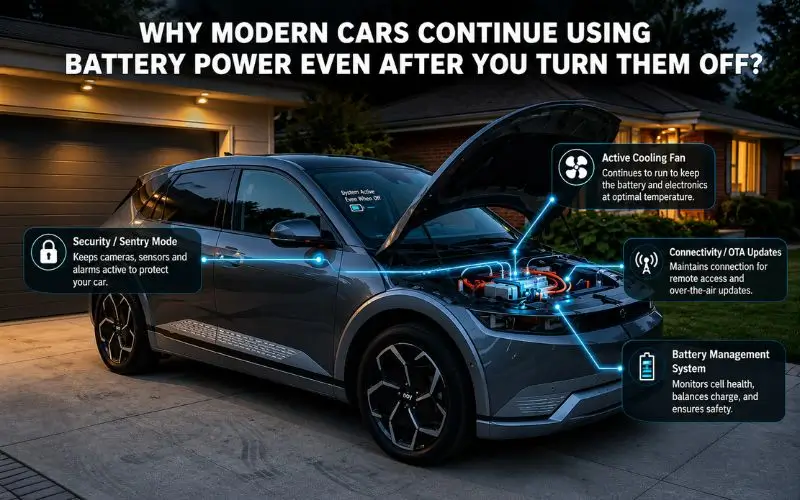
You put the car to rest, lock the car and walk away. As far as you are concerned, everything is off. Inside your car, however, there are some systems awake and working hard to consume a portion of your battery until you’re back. This shouldn’t generally be treated as a fault or a problem. This is the way modern cars are designed.
The difference between a 10-year-old car and the current car is the number of systems that remain active when the ignition is turned off. All of them have a slightly small current. Together they create a consistent drain and can even reduce a healthy battery power to a lightweight in Dubai’s brutal climate quicker than most drivers would anticipate.
Sayara Battery is a trusted car battery replacement in Dubai replacement that is designed to deliver the same performance in a modern vehicle, even after being left “parked” for extended periods without the driver being around.
What Is Parasitic Battery Drain?
After the car is off and the ignition switch is off, the small current that drains from the battery to the various systems in the car is called parasitic drain. The Universal Technical Institute says parasitic battery drain is when power continues to flow even after the engine is turned off.
A healthy modern car with no fault, while in sleep mode, draws between 20 and 50 milliamps of parasitic current. That’s okay, and won’t ruin a good battery under normal circumstances.
The issue is that if any individual systems take more than they are allotted, if multiple systems add their demands on top of one another, or if the heat in Dubai reduces the battery’s capacity to maintain that standing charge between trips.
8 Reasons Your Car Keeps Draining Battery Power When Parked
1. Engine Control Units Staying in Standby Mode
Most modern cars have dozens of electronic control units (ECUs) that control various aspects of the operation, from the engine and transmission to the brakes and steering. When you switch off the car, these modules will not be completely turned off. They switch to a sleep mode with low power consumption, remaining alert to wake up if necessary.
The study published on the medium found 80 to 150 ECUs in modern cars consuming a couple of milliamps when they’re parked. This, combined, can make for a large parasitic draw, particularly in vehicles that are left in the same position for days without driving.
2. Keyless Entry and Smart Access Systems
When you have a keyless entry system, it’s always listening. It constantly transmits a low-frequency signal to identify your key fob in its vicinity, which will unlock the doors when you get closer. This radio frequency receiver will not completely shut off.
This works continuously in busy regions of Dubai such as Dubai Marina, Downtown and near major shopping centres, where dozens of cars park side by side, and waiting for the matching fob signal. Does not use a significant amount of power on its own, but it never ceases to use it.
3. Alarm and Immobilizer Systems
One of the most apparent reasons that the car battery remains energized even when there’s no engine running is its security system. All of the alarm sensors, motion detectors, door triggers and the immobilizer that prevents unauthorized starting are powered around the clock to keep them in an armed state.
This is planned and required. If the security system were to power off when the car was parked, it’s useless. However, that battery is always pumping out a standing current to keep these systems “on” 24/7, whether the vehicle is parked for an hour or a week.
4. Telematics and Connected Car Systems
There are plenty of modern cars, including popular options available in the UAE, that have built-in telematics systems which are connected to the manufacturer’s servers or a fleet management solution. These systems will log the vehicle’s location, monitor the health of the vehicle, report diagnostics, and, in some instances, update software remotely as the vehicle sits in the parking lot.
A telematics unit consumes power even while in deep sleep to keep it connected to the network. If the system is in use, sending or receiving data or an update, that drawing becomes much larger. If you leave your car idle for a few days, you might find that it has a much weaker battery.
5. Infotainment System Memory and Clock Functions
Your infotainment system will keep track of your radio presets, navigation history, paired Bluetooth devices, audio preferences, and display preferences. The information has to be stored and preserved in all of these ways, and the system must constantly have a low-level of power supplied to it to do so.
The internal clock works in the same fashion. It may sound like it isn’t that big of a deal, but the clock in a vehicle has to run on a 24/7 basis and continues to consume electricity while the vehicle is off. Together with the infotainment memory functionality, this makes for a more constant background charge that will not run out of fuel until the battery is fully depleted.
6. Air Suspension and Adaptive Chassis Systems
In Dubai, luxury and premium vehicles such as Range Rover, Mercedes-Benz S-Class models, and BMW 7 Series vehicles are frequently equipped with air suspension systems, which automatically adjust the ride height of the vehicle when it is stationary. These systems are equipped with sensors that help them know if the car has shifted, and they have a compressor to straighten the car back up.
The suspension system can turn on and draw power anytime the vehicle is parked — even at night. If the vehicle sits on uneven ground, in a car park with a sloped floor, or on soft ground, it may cause the suspension system to shake more often or cause the battery to drain faster.
7. Dashcams and Aftermarket Accessories
More and more drivers in Dubai have come to use dashcams, and many of these are connected to a permanent power source to be able to log when a vehicle is stationary, and a movement or collision is detected. If left in parking mode, a dashcam is constantly consuming electrical power throughout the time the vehicle is parked.
GPS trackers, aftermarket alarms, audio amplifiers, and phone charging docks with direct power connections do the same. Individual accessories may attract a reasonable attraction. However, a car that has a dashcam, GPS tracker, and charger for a cell phone plugged in overnight may have a significant reduction in mileage by morning, especially if the battery is already depleted by age or heat.
8. Battery Management and Thermal Systems
The hybrid and plug-in cars sold in Dubai, such as the Toyota RAV4 Hybrid, Lexus RX Hybrid, and other plug-in models, have a battery management system that controls and manages the high-voltage battery pack even when the car is not in use.
These systems monitor the battery’s cell temperature, charge level, and perform cooling/heating cycles to maintain the battery within its preferred operating window.
A hybrid car will be connected to the vehicle’s thermal management system, which will restart and restart multiple times during the day to keep the battery pack cool in the Dubai summer heat. Each activation also uses up the 12V accessory battery, further adding to a heat-stressed component.
How to Reduce Standby Drain and Protect Your Battery?
- When you park for longer than a day, particularly in the summer, unplug all dashcams and accessories.
- Turn off parking mode from dashcams when the battery is more than 2 years old.
- Ensure doors, bonnet, and boot are closed to prevent interior lights and boot lights from being on.
- Park in shaded or covered areas to minimize heat-related self-discharge.
- Run for at least 20-30 minutes regularly to allow the alternator time to fully recharge the battery.
- Have the battery checked every 6 months, especially prior to long journeys or long periods of parking.
Conclusion
When you leave your car in the parking lot, it’s never really off duty. All of your battery’s power continues to be consumed while your car is driving around, day and night, powering the ECUs, security systems, keyless entry receivers, telematics units, dashcams, and suspension systems. This is possible in most climates.
This common standing drain is one of the main culprits for drivers who are forced to go to the dealer for a flat battery in Dubai, where heat causes the batteries to self-discharge, and the battery is already subjected to daily stresses due to AC usage and stop-and-go traffic.
The best thing any Dubai driver can do to not get caught out is to understand what consumes power and minimize unnecessary accessory draw, and to ensure they have enough reserve capacity to support them.
Read Also: Al Jaddaf Metro Station