




Introduction
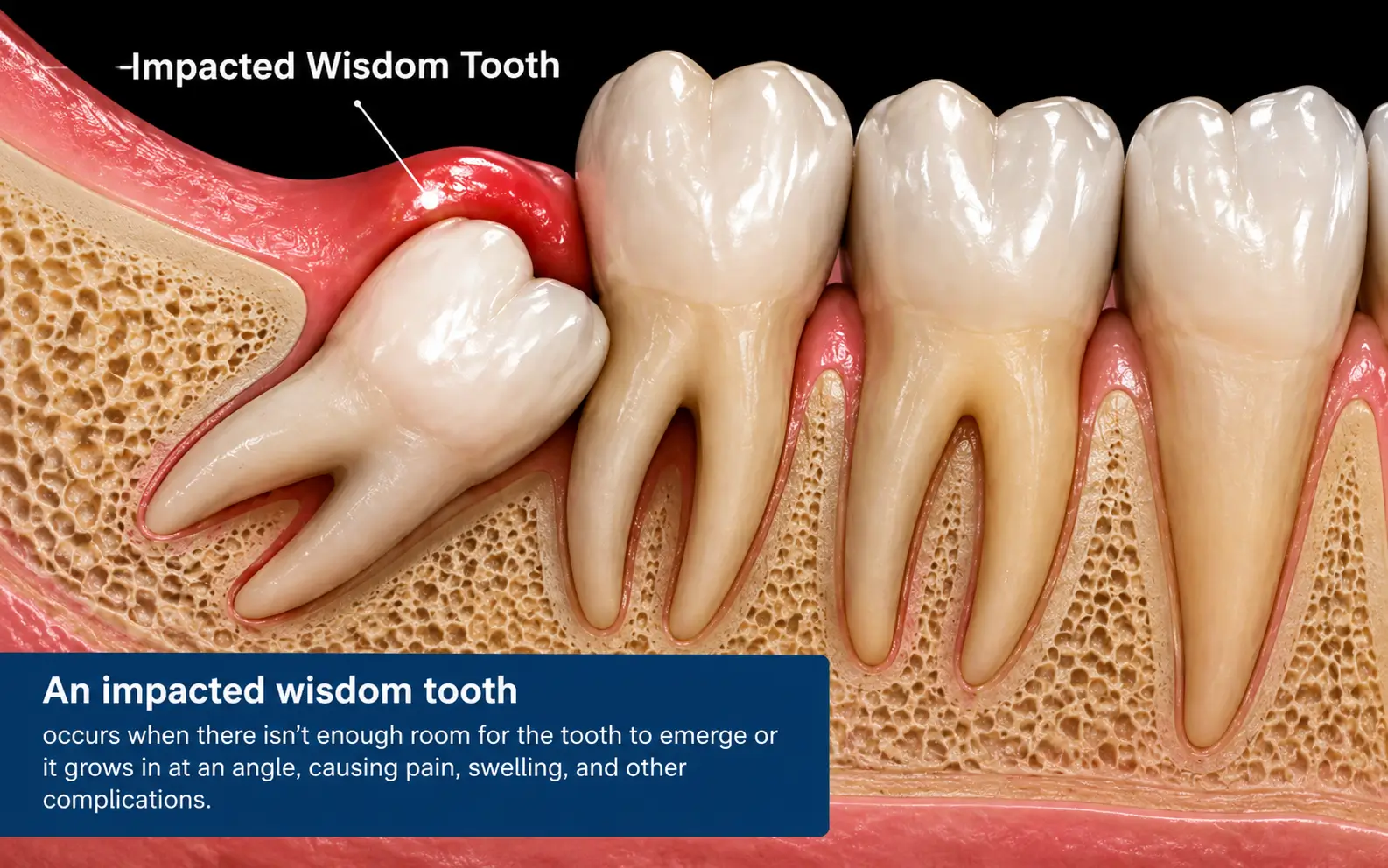
Picture a car trying to squeeze into the last parking spot at a crowded Dubai mall. There is not quite enough room, so it ends up wedged at an angle, half in and half out. That is roughly what happens with impacted wisdom teeth. They try to come through at the back of the jaw, run out of space and get stuck, either partly or completely under the gum and bone. Some impacted teeth cause no trouble for years. Others lead to pain, swelling and infection. When that happens, wisdom tooth extraction is one of the options your dentist may discuss. This guide explains what impaction means, the symptoms to look out for, the risks involved and the treatment options available.
Table of Contents
- What “Impacted” Actually Means
- The Angles an Impacted Tooth Can Take
- Impacted Wisdom Tooth Symptoms
- Risks of Leaving a Problem Tooth Untreated
- Treatment Options
- Recovering From Wisdom Tooth Extraction
- When to Call Your Dentist Straight Away
- Conclusion
- Contact Us
What “Impacted” Actually Means
An impacted tooth is one that cannot fully erupt into its normal position. With wisdom teeth, the usual cause is a lack of space, though the angle of growth or a thick layer of gum or bone can also block the way.
Dentists describe impaction in a few ways:
- Partial impaction: part of the crown has broken through the gum, but the rest is covered.
- Full impaction: the tooth is completely hidden beneath the gum, the bone, or both.
- Soft tissue impaction: only gum covers the tooth.
- Bony impaction: the tooth is partly or fully encased in jawbone.
Partially impacted teeth tend to cause more day-to-day trouble. The small opening in the gum lets food and bacteria in, but it is almost impossible to clean.
The Angles an Impacted Tooth Can Take
An X-ray also shows which way the tooth is pointing. This affects both symptoms and how the tooth would be removed.
- Mesioangular: tilted forward toward the molar in front. This is the most common type.
- Vertical: upright but stuck below the gum or bone.
- Horizontal: lying on its side, pushing into the roots of the neighbouring tooth.
- Distoangular: tilted backwards, toward the back of the jaw.
Horizontal and deeply buried teeth usually take longer to remove than those sitting upright near the surface.
Impacted Wisdom Tooth Symptoms
Some impacted teeth are only discovered on a routine X-ray. When symptoms do appear, they commonly include:
- Aching or throbbing at the very back of the jaw
- Red, swollen gum behind the last molar
- Pain when biting down on that side
- An unpleasant taste or persistent bad breath
- Pus or discharge from the gum
- Stiffness when opening the mouth wide
- Pain that seems to travel to the ear, temple or side of the head
- Swollen glands under the jaw
Symptoms often come and go. A flare-up might settle in a few days, then return weeks or months later, which leads many people to assume the problem has sorted itself out.
Risks of Leaving a Problem Tooth Untreated
Leaving a symptom-free impacted tooth under observation is often appropriate. When a tooth is already causing problems, however, those problems can progress over time. Possible complications include:
- Pericoronitis: repeated infection of the gum flap over a partly erupted tooth.
- Decay: in the wisdom tooth or on the back surface of the second molar, where cleaning is difficult.
- Damage to the neighbouring tooth: a tooth pressing against the root of the molar in front can wear it away.
- Gum disease and bone loss: deep pockets can form between the wisdom tooth and its neighbour.
- Cysts: fluid-filled sacs can occasionally develop around an impacted tooth and affect the surrounding bone.
These are not certainties. Many impacted teeth never develop any of them. Regular monitoring helps catch changes early, when there are more choices available.
Treatment Options
Monitoring. If an impacted tooth is not causing symptoms and X-rays look healthy, your dentist may simply keep an eye on it at regular check-ups. This usually means a review every year or two, with an X-ray when your dentist feels one is needed.
Managing a flare-up. For a mild gum infection, the dentist may clean under the gum flap, suggest warm salt-water rinses and advise on pain relief. Antibiotics may be prescribed if the infection is spreading. This treats the episode but does not remove the cause, so repeated flare-ups usually lead to a conversation about removal. Not every painful wisdom tooth needs to come out, and a tooth extraction is only recommended when the benefits outweigh the risks for your case.
Surgical extraction. Impacted wisdom tooth removal is a minor oral surgery procedure. The typical steps are:
- Local anaesthetic is given to numb the area. Sedation may be offered for anxious patients or more complex cases.
- A small opening is made in the gum.
- If bone covers the tooth, a small amount is removed.
- The tooth may be divided into sections so it can come out through a smaller space.
- Finally, the socket is cleaned and usually closed with a few stitches.
If the roots of the tooth are near the nerve in the lower jaw, a 3D CBCT scan might be carried out before surgery so that the dentist can plan the method to be used for that specific tooth; this kind of planning makes the extraction of the wisdom tooth extraction more predictable, especially in cases where the tooth is situated deep in the bone.
In certain cases where the roots are stightly wrapped around the nerve, the dentist can remove only the crown and leave the roots in place. This helps to reduce the risk of nerve injury, but in a small number of patients a further procedure will be needed if the roots shift.
Recovering From Wisdom Tooth Extraction
The degree of healing differs from person to person, and the initial days are generally the most uncomfortable. Since this is the case with any tooth extraction, proper aftercare makes a real difference to how quickly the area heals. The general aftercare measures include:
- On the first day you should gently bite down on the gauze to stop the bleeding and avoid spitting, rinsing out too hard, using straws and smoking since all these things may dislodge the blood clot.
- For swelling, applying a cold pack to the cheek—using it for 20 minutes on and then 20 minutes off—can be of assistance during the first 24 to 48 hours, although the swelling usually reaches its peak around day two or three.
- For food, choose soft and lukewarm items like yoghurt, soup, mashed potato or scrambled eggs and chew on the opposite side.
- Starting from the following day, gently rinse your teeth with warm salt water after eating and then brush the rest of your teeth as you usually do.
- For relieving pain, take the medicine exactly as your dentist tells you.
- For rest, avoid heavy exercise for a few days and on the first night sleep with your head slightly raised using an extra pillow; in Dubai during summer it is also helpful to stay cool and well hydrated.
Most people find that their condition has improved after one week. The stitches either dissolve on their own or are taken out at the next visit. Recovery following the removal of a wisdom tooth is generally faster when the tooth is standing up and close to the surface than when it is deeply embedded.
When to Call Your Dentist Straight Away
Contact your dentist promptly if you notice:
- Pain that gets worse after day three, often with a bad taste, which may be dry socket
- Bleeding that does not slow with firm pressure on gauze
- Fever or swelling that keeps increasing
- Numbness that has not faded after the anaesthetic should have worn off
One should seek immediate medical help if they have difficulty swallowing or breathing.
Conclusion
It is common for wisdom teeth to be impacted and in many instances they don’t cause any problems. When they do, the typical symptoms are pain, swollen gums, a unpleasant taste and stiffness in the jaw at the back of the mouth. Treatment can range from simple monitoring to having the teeth removed, or in some cases coronectomy. If your dentist carries out a thorough examination and takes the appropriate X-rays, he or she will be able to explain to you the various options available, the risks involved and what recovery will be like, so that you can make an informed decision.
Contact Us
Willing to move on to the next stage? Our DSO team would be pleased to assist you.
Magnum Dental Clinic – DSO
Address: SIT Tower 101, Nr Choitram Super Market, above Baskin Robins Ice-cream, Dubai Silicon Oasis, Dubai, United Arab Emirates
Phone: +971 54 336 3340
Read Also: Al Quoz Medical Fitness Center