



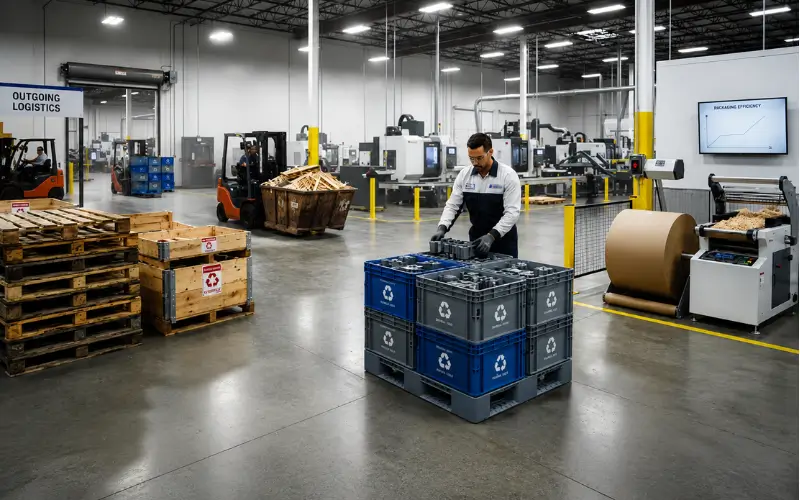
Its ability to change the way manufacturing plants move, store, and protect products is driving them to make changes. Several companies are switching to more robust and useful packaging solutions that can help them run their business more efficiently.
This transformation has the potential to cut down on waste, enhance safety, and lower long-term expenses for companies. The requirement for durable and high-performance packaging in high-use industrial settings is one of the key contributors to this change.
Packaging made from wood frequently breaks, absorbs moisture, causes hygiene issues, and needs to be replaced often. Modern alternatives are easier to clean, facilitate automation, save on maintenance, and offer better protection of the products during storage and transport.
Key Reasons Manufacturing Plants Are Replacing Wooden Packaging
Wooden packaging is being phased out of manufacturing plants due to the need for a stronger, cleaner, and more reliable packaging solution. Damaged pallets, broken crates, or contaminated packaging cannot be tolerated by modern industries.
Several businesses opt for reusable alternatives that are designed to be more efficient in the warehouse and can facilitate the management of the stock.
Crateco Pack LLC plastic pallets also offer businesses a solution that is resistant to wear and tear, allowing them to enjoy long-lasting material handling solutions that are suitable for use in a variety of industrial applications with minimal maintenance.
1. Wood Gets Damaged Easily
Wooden packaging can be used only a few times. Wooden pallets and boxes can crack or split when carrying heavy loads, handling them roughly, or as a result of changing weather conditions.
Loose nails and broken boards can also pose safety hazards to workers. During transportation, if products are not packaged correctly, they can be damaged before arriving at their destination.
Frequent repairs or replacement add extra operating expenses and reduce warehouse activities. Packaging materials are preferred by manufacturers that will enable them to stand up to every day of use.
2. Wooden Packaging Creates Hygiene Problems
In the food processing, pharmaceutical and chemical manufacturing, and retail distribution sectors, cleanliness is critical.
The pores of wood take up water, oil, chemicals, and dirt. This is also problematic when cleaning, and means there is a risk of contamination.
Wooden packaging can also be prone to growth of mold, fungi, and bacteria in a moist environment. Those companies with strict hygiene measures should use packaging materials that are easy to wash and sanitize after each use.
3. Higher Maintenance Increases Operating Costs
The boards are prone to break, or the nails can loosen in wooden pallets; therefore, some repairs are required. Companies repair damaged pallets or get new pallets. Either one of these will cost more in labor and materials in the long run.
Maintenance also generates additional workload for the warehouse personnel. The workers are not producing, but instead are sorting damaged pallets and removing unsafe packaging materials from operations. These unnecessary costs can be averted with the use of durable, reusable packaging.
4. Wooden Packaging Has a Shorter Service Life
While wood may seem cheap at first glance, it is typically not as long-lasting as many reusable options. It loses strength when exposed to heavy products and forklifts for extended periods of time and to the outdoors.
Packaging is utilized in manufacturing plants on a daily basis. Long-term packaging is better value than short-term. This results in a longer service life and improved ROI.
5. Moisture Weakens Wooden Packaging
Numerous manufacturing facilities put products into storage, and humidity changes with the seasons. Wood is a hygroscopic material. This may result in swelling, warping, or rotting.
Wet wood packages that are wet are heavier and weaker. It can also impact the stability of stacked products. Moisture-resistant materials can prevent these issues for manufacturers and ensure they perform in the same manner.
6. Wooden Packaging Is Not Ideal for Automated Systems
Automated warehouses, conveyors, and robotic equipment are utilized in many modern factories. Such systems will need packaging that is of standard size and robust structure.
Over time, wear or moisture can cause wooden pallets to become distorted. The slight variations in size can interfere with automatic handling equipment. Machines perform better with uniform packaging, and production delays are minimised.
7. Worker Safety Is a Growing Priority
Businesses are constantly working to enhance workplace safety. It is possible that the wooden packaging becomes splintered, has exposed nails, or has broken edges. These may lead to injuries when being loaded, unloaded, or handled by hand.
Packaging that is not safe also enhances the risk of work injuries. Rough surface packaging can cause additional harm to workers and create a more hazardous workplace. Smooth surface packaging contributes to creating a safer workplace for workers by using stronger packaging.
8. Reusable Packaging Supports Sustainability Goals
Several manufacturers are striving to minimize waste and enhance environmental performance. The lifespan of wooden packaging is shorter, and its wastefulness is greater when damaged.
Industrial packaging that can be reused can go through several handling cycles before it needs to be replaced.
This will save material and decrease the amount of waste packaging that is disposed of. Better packaging means longer lasting, which helps to foster circular business practices.
9. Better Load Stability Protects Products
Damage to the product may result in lost profits and customer dissatisfaction. Packaging should be able to maintain the stability of the products from the warehouse until the ultimate destination.
Robust reusable packaging can give improved support for heavy loads. Stable stacking minimizes moving during transportation and decreases the risk of damage to the product. Improved load stability also enhances storage efficiency in the warehouse.
10. Easier Cleaning Saves Time
Packaging is usually cleaned at manufacturing facilities, particularly if it comes into contact with food ingredients, medical goods, or industrial chemicals. Wooden packaging is not readily washable due to its ability to absorb liquids.
Smooth industrial packaging surfaces enable quick drying and cleaning. This makes it easier for companies to design packaging for reuse without the extended wait time. The quicker cleaning can be completed, the more efficient a business’s operation and the better the hygiene will be.
11. Better Performance Across Different Industries
There are several industries that use manufacturing plants for a variety of storage and transport needs. Packaging should be factory-, warehouse-, cold storage, and distribution centre-friendly.
Reliable reusable packaging products perform consistently over various operating conditions. Manufacturers can rely on packaging for their automotive parts, packaged foods, electronics, chemicals, or consumer goods that will keep them intact during repeated use.
What Do Manufacturers Look for in Modern Packaging?
The manufacturing plants of today select packaging that boosts productivity and product protection. Companies are not only concerned about how much they pay for a car but also their long-term operating expenses and performance.
Some of the key characteristics are:
- Resistant to multiple uses throughout the day.
- Easy cleaning and improved hygiene.
- Moisture- and chemical-resistant.
- Safe handling of smooth surfaces.
- Uniform size of automated systems.
- Better stacking strength.
- Lower maintenance requirements.
- Long service life.
- Enhanced protection of the product during transportation.
Packaging with these attributes can help manufacturers increase efficiency and cut down on excess operational costs.
Wooden Packaging vs Modern Reusable Packaging
The purchasing price is not the only consideration when it comes to choosing the right packaging. Durability, maintenance, hygiene, and long-term performance are factors that are taken into consideration by manufacturers.
It becomes apparent, when you compare traditional wooden packaging to modern-day reusable packaging, why it is easier for many manufacturing facilities to upgrade their material handling.
The major differences are summarized in the table below.
| Feature | Wooden Packaging | Modern Reusable Packaging |
| Durability | Can crack, split, or break under heavy use | Designed for repeated industrial use |
| Hygiene | Absorbs moisture, dirt, and bacteria | Easy to clean and sanitize |
| Maintenance | Needs frequent repairs and replacements | Requires very little maintenance |
| Worker Safety | May have splinters and exposed nails | Smooth edges reduce handling risks |
| Moisture Resistance | Can swell or rot when wet | Resistant to moisture and humidity |
| Automation Compatibility | Size may change over time | Consistent dimensions for automated systems |
| Service Life | Shorter lifespan | Long-lasting and reusable |
| Long-Term Cost | Higher due to regular replacement | Lower because of extended use |
| Environmental Impact | Creates more packaging waste | Supports reuse and waste reduction |
How to Make the Switch From Wooden Packaging Successfully?
Transitioning from wooden packaging to reusable packaging must be well thought out. A smooth transition enables manufacturers to optimise operations without downtime. By following a couple of simple steps, it will be easier and will give better results.
1. Review Your Current Packaging Process
To begin, you should pinpoint where wood packaging is being applied and its frequency of need for repair or replacement. This allows you to identify current costs and where improvements could make the greatest difference.
2. Choose Packaging Based on Application
Products require a variety of packaging solutions. Before choosing the packaging, take into account factors like product weight, storage conditions, stacking needs, and transportation options.
3. Check Equipment Compatibility
Ensure the new packaging is compatible with forklift trucks, pallet jacks, conveyors, racking systems, and existing automated equipment in the facility. High compatibility streamlines workflow and minimises handling issues.
4. Train Warehouse Employees
Offer minimal training on proper handling, stacking, cleaning, and storage procedures. Ensuring that reusable packaging is used appropriately extends the useful life and minimises damage.
Once the changes have been implemented, monitor performance.
After switching to the new product, monitor key metrics like product damage, maintenance costs, packaging life, and warehouse productivity. By regularly monitoring the benefits, manufacturers can see how much more they can improve.
Conclusion
Wooden packaging isn’t so popular because it’s just a fad or preference; it’s out of use because it’s simply a practical business decision. Manufacturers require packaging to be more robust, clean, safe, and to fulfil the requirements of modern warehouse environments.
Using durable, reusable solutions can lead to fewer maintenance issues, better hygiene and safety, better product protection, and overall chain efficiency.
The ongoing modernization of industries, however, will continue to require the replacement of traditional wooden packages with plastic pallets and other reusable material handling solutions for a safer, more efficient, and cost-effective manufacturing environment.