
Key Takeaways
- Both Free Zone and Mainland companies now allow 100% foreign ownership for most activities – the old requirement for a local Emirati sponsor is gone in the vast majority of sectors.
- A Free Zone company only gets the 0% Corporate Tax rate on qualifying income if it meets Qualifying Free Zone Person (QFZP) conditions each year – it is not automatic, and losing QFZP status pushes the entire company onto the standard 9% rate for the current year and four years after.
- Mainland companies can trade anywhere in the UAE and bid on government contracts; Free Zone companies cannot sell directly into the mainland market without a local distributor, agent, or dual licence.
- Offshore companies cannot lease office space, sponsor visas, or trade within the UAE at all – they exist purely for holding assets, international trade, and structuring, not for running an operating business in Dubai.
Introduction
Anyone considering business setup in Dubai free zone areas eventually hits the same fork in the road: Free Zone, Mainland, or Offshore. The right answer depends on where your customers are, whether you need visas, and how much market access matters versus tax efficiency.
This guide breaks down all three structures side by side, with an updated look at how the UAE’s Corporate Tax regime – and specifically Qualifying Free Zone Person (QFZP) status – actually affects which one comes out ahead for your business in 2026.
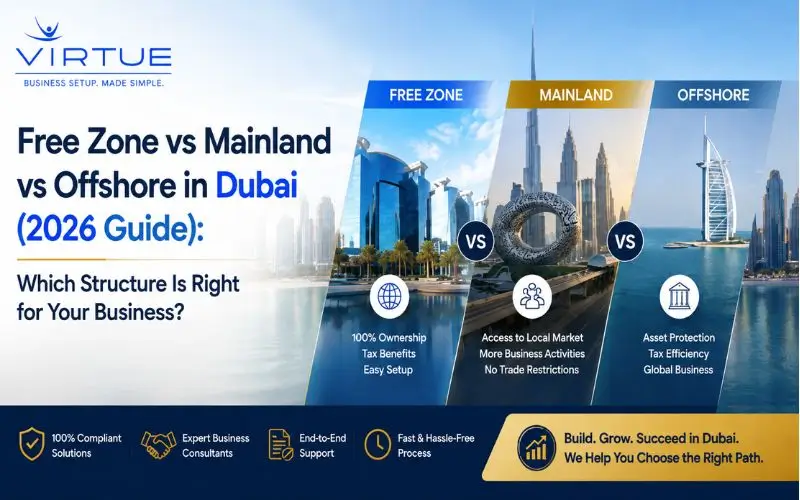
Quick Comparison: Free Zone vs Mainland vs Offshore
| Free Zone | Mainland | Offshore | |
| Foreign ownership | 100% | 100% (most activities) | 100% |
| UAE market access | Indirect only (agent/distributor/dual licence) | Full, direct access | None |
| Physical office | Optional (flexi-desk/virtual available) | Mandatory (min. ~200 sq ft) | Not permitted |
| Visa eligibility | Yes, tied to office size (typically 3–6) | Yes, tied to office size | No |
| Corporate Tax | 0% on qualifying income if QFZP; 9% otherwise | 9% above AED 375,000 profit | 0% on qualifying income (QFZP), 9% on non-qualifying net profit above AED 375,000 |
| Best for | Export, services, holding IP, regional HQs | Retail, government contracts, UAE-wide trade | Holding companies, international structuring |
Free Zone Companies in Dubai
What is a Free Zone company?
A Free Zone company is registered within one of the UAE’s 40+ designated economic zones, each regulated by its own Free Zone Authority rather than a mainland Department of Economy. These zones span every emirate, not just Dubai, and most specialise in particular industries even though they typically allow a broad range of activities. Here’s a quick look at some of the most commonly referenced zones:
Dubai
- Meydan Free Zone – popular for professional services and trading licences, known for accessible entry pricing and relatively fast processing.
- IFZA (International Free Zone Authority) – one of Dubai’s most cost-competitive zones for startups and consultants, with flexible multi-activity licences and remote registration options.
- Dubai South – built around Al Maktoum International Airport and air cargo, a strong fit for e-commerce, logistics, and import/export businesses reliant on air freight.
- JAFZA (Jebel Ali Free Zone) – one of the UAE’s oldest and largest zones, anchored to Jebel Ali Port; the natural choice for sea freight, bulk commodities, and heavy manufacturing supply chains.
Sharjah
- SPC Free Zone (Sharjah Publishing City) – originally built for publishing, now broadened to e-commerce, consultancy, and trading, known for its dual-licensing option that allows both free zone and mainland operation.
- SHAMS (Sharjah Media City) – geared toward media, consultancy, and e-commerce, notable for allowing registration without the “FZ” suffix in the company name and fast digital licence issuance.
- SRTIP (Sharjah Research Technology and Innovation Park) – focused on R&D, tech, and innovation-driven businesses, positioned near universities with a research-oriented ecosystem.
Ajman
- Ajman Free Zone (AFZA) – one of the more established and cost-effective zones, supporting trading, manufacturing, service, and e-commerce activities.
- Ajman NuVentures Centre (ANCFZ) – a newer Ajman zone with straightforward licence packages and no high fixed minimum capital requirement for most activities.
Ras Al Khaimah
- RAKEZ (Ras Al Khaimah Economic Zone) – well suited to manufacturers and industrial businesses, generally at a lower cost than Dubai zones, though the RAK address can carry less weight with clients who expect a Dubai registration.
The core structure – 100% foreign ownership, no direct mainland market access without an agent, and the same Corporate Tax and QFZP rules – is broadly consistent across all of them; the differences tend to come down to industry focus, cost, and visa allocation.
Ownership structure
Free Zones were built around 100% foreign ownership from the start, which is why they remain the default choice for founders who don’t want a local partner or sponsor involved in equity.
Business activity and market access
This is the single most misunderstood point in UAE company formation: a Free Zone company cannot sell directly to mainland UAE customers. To reach the mainland market, a Free Zone company needs to work through a local distributor or agent, or apply for a dual licence where the free zone allows it. If your customers are mostly outside the UAE, or you’re selling B2B services that don’t require a mainland presence, this restriction rarely matters in practice.
Office requirements
Free Zones offer the widest range of office options in the UAE – from flexi-desks and virtual offices up to full physical space, which keeps setup costs flexible for early-stage businesses.
Visa eligibility
Visa allocation is tied to your office package. A flexi-desk typically supports up to 3 visas, while larger serviced or physical offices scale up from there – the exact numbers vary by free zone.
Corporate Tax and Qualifying Free Zone Person (QFZP) status
This is where most guides – including most of what’s published on this topic – stop short. Free Zone companies are not automatically tax-exempt. Since the UAE introduced Corporate Tax, every Free Zone entity is a taxable person and must register with the Federal Tax Authority (FTA). To actually pay 0% on qualifying income, a company must meet the conditions to be recognised as a Qualifying Free Zone Person (QFZP) under Article 18 of the Corporate Tax Law, which broadly requires:
- Maintaining adequate substance in the UAE (real operations, not just a licence)
- Earning “qualifying income” as defined by the FTA, and keeping non-qualifying income within a strict de minimis threshold (the lower of 5% of total revenue or AED 5 million)
- Complying with transfer pricing rules for related-party transactions
- Preparing and maintaining audited financial statements annually
Qualifying income taxed at 0% and non-qualifying income within the de minimis limit at 9% is the standard split. Fail any single condition, and QFZP status is lost entirely – not just for the affected income stream, but for the whole company, which then falls onto the standard 9% rate for that tax year and the four tax years that follow. This is a meaningfully harsher penalty than most business owners realise going in, and it’s why QFZP compliance needs to be treated as an ongoing requirement, not a one-time registration checkbox.
Separately, free zone companies with revenue under AED 3 million can elect Small Business Relief instead – but doing so means giving up QFZP benefits for that period, so the two aren’t stackable.
Cost of setup
Free Zone setup costs vary significantly by zone and typically include a company registration fee, licence fee, office fee, and share capital requirement – DMCC and Meydan, for example, sit at different price points depending on licence type and office package.
Spotlight: DMCC Free Zone
DMCC (Dubai Multi Commodities Centre) is one of the most established free zones in Dubai, based in the Jumeirah Lakes Towers (JLT) district, and a common reference point for anyone comparing free zone options.
DMCC company formation generally follows a standard sequence: choose your licence activity, reserve a trade name, get initial approval, select an office package (which determines your visa quota), then submit for licence issuance.
DMCC trade licence types include commercial, service, and industrial licences, depending on the nature of your business activity.
DMCC licence cost depends on your chosen office type and activity – flexi-desk packages sit at the lower end, with costs increasing for serviced offices and physical space, plus annual renewal fees.
JLT free zone company registration follows the same DMCC framework, since JLT sits within DMCC’s jurisdiction – it’s often referenced separately because of the physical district name.
Spotlight: Meydan Free Zone
Meydan Free Zone has become a popular alternative for founders comparing setup costs across Dubai’s free zones, particularly for professional services and trading licences. Business setup in Meydan Free Zone typically appeals to founders prioritising faster processing and more accessible entry pricing compared to some of the more established zones – though as with any free zone, actual cost and processing time depend on your specific activity and visa requirement.
Mainland Companies in Dubai
Ownership structure
Since December 2020, mainland companies have also been eligible for 100% foreign ownership across most business activities, removing what used to be the biggest structural difference between Mainland and Free Zone.
Business activity and market access
This is the core advantage of Mainland: a company licensed by the Department of Economy and Tourism (DET) can trade anywhere in the UAE, take on government contracts, and operate without needing a local distributor to reach mainland customers.
Office requirements
Mainland companies must lease a minimum of roughly 200 sq ft of physical office space – virtual offices are not permitted, unlike Free Zone.
Visa eligibility
Visa numbers scale with leased office space, generally calculated per square footage, so larger premises support more visas.
Corporate Tax
Mainland companies are subject to the standard 9% UAE Corporate Tax rate on profits exceeding AED 375,000 – there’s no QFZP-style 0% mechanism available to them.
Cost of setup
Mainland setup typically costs more upfront than a comparable Free Zone package, once licence fees, office rent, DET approvals, and Ministry of Economy registration are factored in.
Offshore Companies in Dubai
Offshore is the structure most guides gloss over, but it serves a genuinely different purpose from Free Zone or Mainland – it’s not really a competing option so much as a different tool.
An offshore company (such as those registered through JAFZA Offshore or RAK ICC) is designed for:
- Holding assets – property, shares in other companies, intellectual property
- International trade and invoicing that doesn’t touch the UAE market directly
- Tax and estate planning structures, often used alongside a UAE operating company
What offshore companies cannot do: lease physical office space in the UAE, sponsor employee or investor visas, or trade directly with UAE-based customers. If your goal is to actually operate and be present in the UAE, offshore isn’t a substitute for Free Zone or Mainland – it’s typically layered on top of one of them, not instead of it.
Corporate Tax for offshore companies: Offshore companies are not exempt from UAE Corporate Tax registration – this is a common misconception. Registration with the FTA is mandatory, the same as it is for Free Zone companies. The tax mechanics also follow the same QFZP framework: 0% Corporate Tax on qualifying income where QFZP conditions are met, and 9% on non-qualifying income once net profit exceeds AED 375,000.
Full Comparison Table
| Criteria | Free Zone | Mainland | Offshore |
| Ownership | 100% foreign | 100% foreign (most activities) | 100% foreign |
| Market access | Indirect (agent/distributor/dual licence) | Full UAE + international | None – international only, no UAE trading |
| Office | Optional – virtual to physical | Mandatory, min. ~200 sq ft | Not applicable |
| Visas | Yes, tied to office package | Yes, tied to office size | Not eligible |
| Corporate Tax | 0% on qualifying income if QFZP; 9% otherwise | 9% above AED 375,000 profit | 0% on qualifying income if QFZP; 9% otherwise |
| Regulator | Individual Free Zone Authority | Department of Economy and Tourism (DET) | Offshore registrar (e.g. JAFZA Offshore, RAK ICC) |
| Typical use case | Export/services businesses, regional HQs, holding companies | Retail, government contracts, UAE-facing trade | Asset holding, international structuring |
Frequently Asked Questions
Can a Free Zone company do business in mainland UAE?
Not directly. A Free Zone company needs to work through a local distributor or agent, or hold a dual licence, to sell to mainland customers. To operate freely across the UAE without that arrangement, you’d need a Mainland licence.
Can I convert a Free Zone licence to Mainland?
Not as a simple upgrade – you’d need to cancel the Free Zone licence and apply fresh for a Mainland licence through the DET, which is treated as a new business setup with its own approvals.
Can a foreigner own 100% of a Dubai company?
Yes, in both Free Zone and Mainland structures, for the vast majority of business activities. A small number of strategic sectors still require UAE national involvement.
How much does a Free Zone company cost?
It depends heavily on the free zone, licence activity, and office package – costs generally include a registration fee, licence fee, office fee, and share capital, and vary significantly between zones like DMCC, Meydan, and others.
Does a Free Zone company pay Corporate Tax?
It depends on whether the company qualifies as a Qualifying Free Zone Person (QFZP). Qualifying income is taxed at 0%; non-qualifying income and companies that don’t meet QFZP conditions are taxed at the standard 9% rate.
What about offshore companies – can they operate in the UAE?
No. Offshore companies can’t lease office space, sponsor visas, or trade directly within the UAE. They’re used for holding assets and international structuring, typically alongside a Free Zone or Mainland operating company rather than instead of one.
Do offshore companies pay Corporate Tax in the UAE?
Yes – Corporate Tax registration is mandatory for offshore companies, just as it is for Free Zone companies. The same QFZP mechanism applies: 0% on qualifying income if conditions are met, and 9% on non-qualifying net profit above AED 375,000.
Which Structure Is Right for You?
If your business sells internationally or provides services with no need for a mainland office, Free Zone usually offers the fastest, most cost-flexible route – provided you plan for QFZP compliance from day one rather than assuming the 0% rate applies automatically.
If your customers are primarily in the UAE, or you’re pursuing government contracts, Mainland gives you direct access without needing a distributor arrangement.
If you’re structuring for asset holding or international trade rather than UAE operations, Offshore works alongside – not instead of – one of the above.
At Virtue Corporate Services, we help entrepreneurs, startups, SMEs, and global businesses establish and grow with confidence. As one of the trusted Business Setup Consultants in Dubai, we provide end-to-end business setup solutions, including company formation, trade licensing, PRO services, visa assistance, banking support, and compliance guidance. Our experienced team simplifies the entire process, allowing you to focus on building your business while we handle the legal and administrative requirements. With over 3,000 successful company setups and clients from 130+ countries, we are committed to delivering transparent, efficient, and personalized services. Whether you’re launching a new venture or expanding into the UAE, Virtue Corporate Services is your trusted business partner.
Get in touch with Virtue Corporate Services to find the right structure for your business.
Read Also: Sheikh Zayed Road