





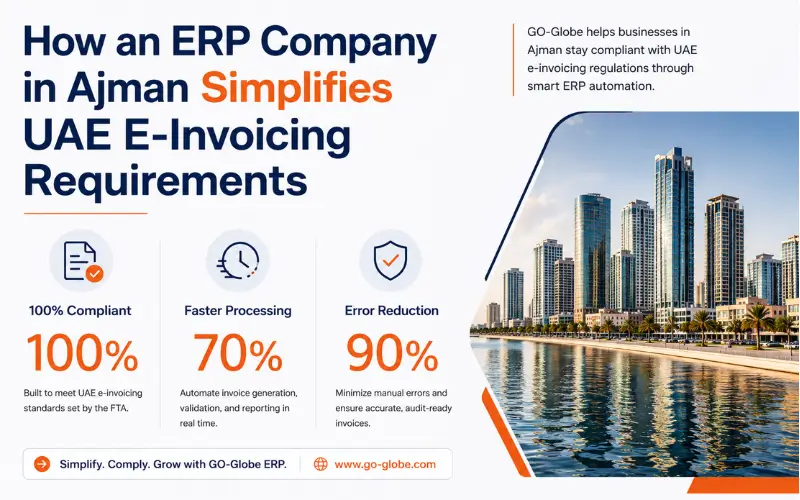
The UAE is making rapid strides towards e-invoicing. In all industries, businesses are required to keep pace with the changes. This change is not an option. This must be done legally and will be a game-changer in how companies perform billing, tax reporting, and financial record-keeping.
This change may be too much for too many businesses in Ajman. New Rules = New Systems. With new systems come new processes. This is where an ERP company Ajman that businesses can rely upon can make a huge difference.
This article covers the UAE e-invoicing and its implications for businesses based in the UAE. It also demonstrates how the right ERP partner can help navigate a challenging mandate to a seamless and manageable process.
What Is UAE E-Invoicing?
E-Invoicing involves the transmission of the details of an invoice through an electronic means between businesses and tax authorities. What companies should be developing are digitally structured invoices, not just paper-based invoices, nor even the simple PDF file. The standard invoice format is used for these invoices. They are directly linked with the reporting system of the Federal Tax Authority.
The goal is simple. The UAE government wants to combat tax evasion and enhance transparency, as well as speed up VAT reporting. The change comes on the heels of comparable reforms that have already taken place in numerous parts of Europe and the Gulf region.
This means that businesses won’t be able to create and send invoices any longer. They all must meet very strict technical and data criteria. There are some required fields, formats, and checks that should be carried out every time an invoice is issued to the buyer or to the tax office.
Why This Matters for Ajman Businesses
Ajman has a growing base of small and mid-sized businesses. A lot still use manual systems or simple accounting packages. The older systems were not designed to accommodate any standards for e-invoices.
Businesses run the risk of:
- Non-compliance penalties. Late or incorrect invoice information may result in fines.
- Delayed payments. If an invoice is rejected due to validation issues, the payment process could take a toll on the organization.
- Manual errors. Manual data entry raises the likelihood of errors, which could lead to rejection.
- Operational strain. Staff can be overwhelmed by the addition of the new reporting steps, in addition to their regular workload.
Hence, there is a need to install an ERP system provider who is reliable in the Ajman region that can do it in less time. A modern ERP system streamlines the invoicing process and cuts down on the risks and time.
How ERP Software Solves the E-Invoicing Challenge
ERP software connects all the elements of a business into a single platform. All sales, accounting, inventory, and compliance are connected. This is relevant for e-invoicing as invoice data is used in almost all transactional aspects.
The following are some of the primary challenges of e-invoicing addressed by the right ERP software that Ajman businesses can adopt.
Automatic Invoice Generation
An ERP system creates an invoice based on sales and transaction details. This eliminates the need to manually enter this information. This also guarantees that every invoice is in the proper format from the beginning.
Built-In Compliance Checks
Today’s ERP solutions feature rules and validations that meet the UAE tax regulations. These rules are checked before sending the invoice. This will identify errors early, before they become compliance problems.
Real-Time Tax Authority Integration
E-invoicing calls for a direct connection involving the enterprise systems and the government reporting systems. This integration is part of ERP systems designed for the UAE market. This integration is one of the features in ERP systems that are tailored for the UAE market. No manual uploads; invoices are automatically transferred from the business to the tax authority.
Centralised Record-Keeping
All the data relating to invoices is kept in a single location. This simplifies the audit process. It also provides finance teams instant access to records when needed.
Reduced Human Error
Manual invoicing is the primary cause of invoice errors. A lot of this risk can be eliminated by ERP automation. Fields populate automatically. Manual data entry is not required for calculations. This results in reduced invoice rejection and delayed payments.
The Role of a Local ERP Partner
It’s not an all-technology solution. Businesses require assistance to use it properly. That’s where the Ajman ERP company team comes in handy.
Understanding Local Regulations
The rules for e-invoicing in the UAE are constantly developing. A local ERP partner remains abreast of these changes. They know the particular needs required by the Federal Tax Authority and can modify their methods when the rules change.
Faster Implementation
A local team is available to respond swiftly. They have an appreciation for the business environment of Ajman. This translates into a quicker installation, a faster problem-solving process, and less downtime during the transition.
Tailored Support
All businesses are unique. There are different types of invoices that different businesses might need. A retail shop will not have the same invoicing requirements as a construction company or trading company. A good ERP partner tailors the system to the specific business model, as opposed to making it fit into a standard mold.
Ongoing Maintenance
The future of E-Invoicing in UAE is likely to be impacted due to the continuous development of the UAE’s digital tax framework. A dependable partner offering ERP development Ajman services provides ongoing updates, ensuring the system stays compliant long after the initial rollout.
Key Features to Look for in an E-Invoicing-Ready ERP System
Not every ERP solution comes with the same specs. These are key features that businesses should consider when preparing for UAE e-invoicing.
- Standard format support. The system should create the required structured format of invoices in the format agreed to by FTA for the moment, such as XML, UBL, etc.
- Automated validation. Search the system for pre-submission validation, such as missing fields, invalid tax codes, or data formatting.
- Direct FTA connectivity. The system needs to be connected to the appropriate government reporting systems, and there should not be manual systems involved in data transfer.
- Multi-currency and multi-language. There are many of the Ajman businesses that deal with international clients. The system should be capable of supporting multiple currencies and languages without any hassle.
- Scalability. The ERP system must be scalable as the company expands, without the need for a full transformation of the system.
- Strong data security. Invoicing includes financial information, so the system should have robust access management and security measures, including encryption.
The Business Benefits Beyond Compliance
Compliance is the obvious motivation, but there are so many benefits to ERP-based e-invoicing for businesses.
- Faster payment cycles. Approving automated, error-free invoices takes place much quicker. This helps manage cash flow.
- Better financial visibility. All invoice data is at the fingertips of finance teams, providing them with better visibility of revenue, outstanding payments, and cash position.
- Reduced administrative costs. Automation reduces human time concerning manual generation and correction of invoices.
- Stronger client relationships. Prompt and correct invoicing helps to minimize disputes and foster trust with business partners.
- Audit readiness. Organised digital records enable businesses to respond to audits swiftly and confidently.
Common Mistakes Businesses Make During the Transition
There are many businesses that fail during the transition to e-invoicing. These errors can cost you time and money.
- Deferring the beginning. E-invoicing deadlines are not flexible. Failure to implement will mean that businesses may sprint at the end of the day.
- Selecting a generic system. Not all software will work with UAE-specific formats and rules. Compliance requirements may not be met with a generic accounting tool.
- Skipping staff training. The most well-designed system is of no use if the staff members don’t know how to use it properly. Expensive mistakes can be avoided by proper training.
- Ignoring future scalability. A system that can expand with the business is the one to be selected, rather than the one that will have to be replaced within a year or so.
- Underestimating support needs. The rules pertaining to e-invoicing can change. The ERP provider’s continued support helps maintain compliance as time goes on.
Preparing Your Business for the Transition
While it might seem distant, businesses in Ajman need to start preparing for full regulations to be implemented. Last-minute compliance issues and stress can be avoided with the help of early preparation.
The first step is to review existing invoicing procedures. Create the differences between the existing systems and the UAE e-invoicing requirements. Then check out ERP solutions that are proven successful within the geographical region.
Inquire about when a clear implementation timeline will be possible with potential partners. Inquire about continuous support and how they deal with changes in regulations. Last but not least, schedule staff training in advance of the system going live.
The Future of E-Invoicing in the UAE
The UAE’s move towards digital tax reporting is part of a global trend. Across the world, governments are stepping in the direction of a tax regime that can be made more transparent, with tax information being made available in real time. It is easier to be flexible and adapt early on rather than late.
As the system continues to develop, its ability to link with government reporting solutions should be refined. Modern and well-supported ERP systems will ease the transition for businesses compared to those with older systems.
Final Thoughts
UAE e-invoicing is a substantial shift in the manner that businesses are dealing with financial details. This transition can open up new opportunities and challenges for businesses in Ajman. Firms that make rapid adjustments will be those with the right technology and people on board.
With a company that specializes in ERP, Ajman businesses can make this complex requirement manageable and even a positive business upgrade. The right system does not conform to compliance. It boosts efficiency, it provides greater financial clarity, and it provides a foundation for growth.
By offering a comprehensive suite of services and support, GO-Globe equips businesses with the tools necessary to seamlessly integrate ERP solutions into their operations and confidently meet UAE e-invoicing standards. GO-Globe can assist businesses in meeting the UAE e-invoicing requirements and implementing ERP solutions successfully with its knowledge and expertise.