
Dubai has a contemporary and structured public transport system. This network is run by the Roads and Transport Authority (RTA). It consists of trams, metro lines, buses, and marine transportation. The services make people move around in the city with ease. Another component of this system is feeder buses, since they help to link residential areas to adjacent metro stations.
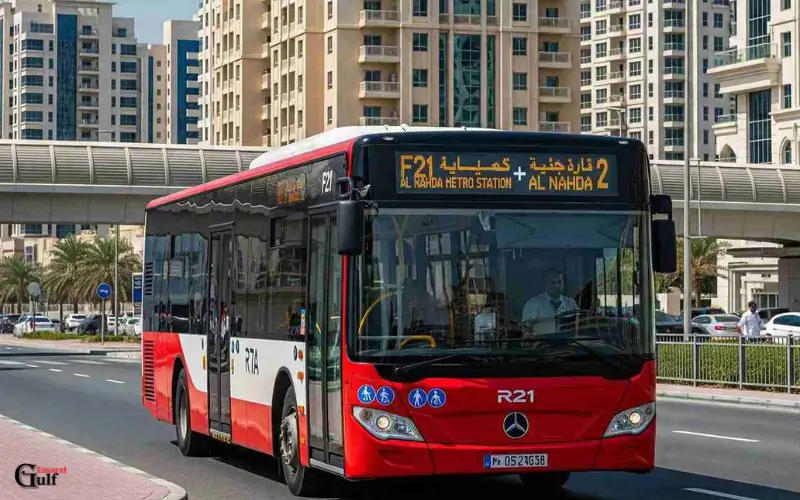
The F21 bus route is one of the vital service feeders. It serves the Al Nahda area and links the local neighborhoods with Al Nahda Metro Station. This linkage assists most of the commuters to the metro in a short time. Consequently, it makes it easier to travel every day for thousands of passengers.
Office workers, students, and families are the typical users of the service. A great number of citizens rely on trains as a mode of transportation. Al Nahda is a residential area that is densely populated. Due to this, there is an effective feeder bus network that enables the residents to access the metro and move to other parts of Dubai.
Key Route Information
| Detail | Information |
| Route Name | F21 Bus |
| Bus Type | Metro feeder service |
| Starting Point | Al Nahda Metro Bus Stop |
| Ending Point | Al Nahda Metro Bus Stop |
| Total Stops | Approximately 20–22 stops |
| Average Journey Time | 20–30 minutes |
| Fare | Starting from AED 3 with Nol card |
Location
The route provides services in the Al Nahda district of Dubai. This is in the northeastern region of the city and close to the Dubai-Sharjah border.
The neighborhood is characterize by residential apartment high-rise, educational facilities, parks, supermarkets, and hospitals.
The main landmarks around it are:
- Al Nahda Metro Station
- Al Nahda Park
- NMC Medical Centre
- Several residential high-rise buildings and business centers.
The bus route is important as the community will have access to the metro station and other facilities due to its strategic positioning.
Major Bus Stops
The path incorporates a number of major ones which are located close to residential houses, learning institutions, and open services.
Important Stops on the Route
- Al Nahda Metro Bus Stop
- Bus Stop in the Ministry of Information.
- Al Nahda 1 – DEWA Office
- Al Maaref Private School
- NMC Medical Centre
- Canary Building
- Madina Supermarket
- Al Noor Building
- Al Hawai Twin Towers
- Ahli House Building
- Al Shawi Tower
- Desert Group Building
- Al Nahda Park Bus Stop
- Emirates Driving Institute
- Ministry of Economy of the Republic of the United Arab Emirates.
These stops are also strategically located in such a way that people living throughout the neighborhood can get access to public transport at a reasonable walking distance.
Schedule and Operating Hours
The steady schedule is among the reasons why commuters use the F21 bus route. The service runs on a daily basis with frequent departures during the day.
Typical Bus Schedule
| Day | First Bus | Last Bus |
| Monday – Thursday | Around 4:30 AM | Around 12:00 AM |
| Friday | Around 4:30 AM | Around 1:00 AM |
| Saturday | Around 4:35 AM | Around 12:00 AM |
| Sunday | Around 7:30 AM | Around 12:00 AM |
Buses usually run between 10 and 20 minutes, depending on the time of day. Buses run more often to the areas with a high number of passengers during the peak hours when the number of people who use the bus is high.
Must Visit: Shahama Bus Station Abu Dhabi | Tips, Routes, and Nearby Attractions
Fare and Payment System

The city of Dubai has a smart card-based transportation system named the Nol card. With the help of this card, passengers are able to ride on buses, the metro, and trams without cash.
The passengers just need to tap the card when they get into the bus and also when they get out. The fare will automatically be computed according to the travelled zones.
Fare Details
| Travel Type | Cost |
| Minimum Bus Fare | AED 3 |
| Two-Zone Travel | AED 5 |
| Three-Zone Travel | AED 7.5 |
The above pricing concept renders the use of public transportation affordable to the day-to-day commuters.
The contemporary transport systems in the UAE are established on intelligent payment systems such as Nol cards, and they have made life easier and more convenient when travelling.
Passenger Facilities
The buses that serve as feeders in Dubai are supposed to be comfortable and safe for the riders. The buses are contemporary, air-conditioned, and fitted with a number of facilities.
Key Passenger Amenities
- Entirely air-conditioned interiors.
- Seat arrangement of a comfortable type.
- Preferential seating of aged and handicapped passengers.
- Electronic signs with future destinations.
- CCTV cameras for safety
- Special wheelchair accessibility.
These characteristics render the bus service convenient to the residents, tourists, and individuals with special mobility requirements.
Importance of Feeder Bus Services
The transportation systems in cities are based on high interdependence of various forms of transport. The metro networks are not able to cover all residential areas; thus, the feeder buses are needed.
The F21 bus route is a route that provides an interface between residential areas and the metro. In the absence of feeder services, a significant number of commuters would be forced to use taxis or their personal cars to get to a metro station.
There are several benefits of feeder buses:
- Short-distance transportation at low cost.
- Fewer traffic jams on the urban roads.
- Easy access to metro stations.
- Eco-friendly mode of commuting.
These services are relevant to long-term urban mobility.
You Also Like: Mussafah Bus Station | Routes, Timings & Facilities in Abu Dhabi
Travel Tips for Passengers

The F21 bus route can be easy and effective to use, provided that you keep a number of practical tips in mind. One thing is to always make sure that your NOL card has a sufficient balance before entering the bus. You can use your card to avoid wasting time in the metro stations or ticket machines.
Second, whenever you can, consider planning your travel when there is low traffic. There is normally an increase in the number of passengers during the morning and evening rush hours, and this may cause overcrowding on the buses.
Third, be at the place of the bus stop a few minutes earlier than the time the bus is due. Although buses have a schedule, there are times when traffic can influence the arrival time.
Lastly, note down announcements or the digital board inside the bus so that you get out of the bus at the right place. Feeder buses are a reliable choice of transport in the daily routine, as the UAE public transport systems are focused on punctuality and passenger comfort.
Future Improvements in Dubai’s Bus Network
Dubai is still investing in superior transport systems to accommodate its fast-increasing population. The RTA checks bus routes on a regular basis and also develops new technology to make bus services more efficient.
The next stage of enhancement can be electric buses, smart traffic systems, and new real-time passenger information services.
The city has already launched a number of smart mobility projects that are aimed at building a more sustainable and accessible transportation system.
Conclusion
The route of the F21 bus is a very critical component of the public transport in Dubai, particularly for the people of the Al Nahda district. The service will connect residential areas to Al Nahda Metro Station, thus enabling commuters to use other metro routes at a low cost.
The bus has over twenty stops, regular departures, and a simple circular route structure, which makes it an effective way of transportation for thousands of clients daily.
The route is a good option because of affordable prices, high-end buses, and comfortable passenger service,, which ensures student, professional, and visitor reliability. With Dubai still developing its transportation infrastructure, feeder services such as this one will be essential for smooth and accessible urban mobility.
Must Visit: Business Bay Metro Station | Location, Timings 2026 & Connectivity in Dubai
Business Bay Metro Station Exit 1 Dubai | Location, Timings And Nearby Landmarks
FAQs
What is the F21 bus route in Dubai?
It is a feeder bus, and it serves the residential areas in Al Nahda to the Al Nahda Metro Station.
Where does the F21 bus start and end?
It starts and ends at Al Nahda Metro Bus Stop, and it is a circular feeder route.
How long does the bus journey take?
An entire journey normally takes about 20 to 30 minutes, depending on traffic.
What is the fare for the bus?
The lowest fare is AED 3 when riding a Nol card.
How many stops are on the route?
It covers about 20 to 22 destinations in the Al Nahda district.
How frequently do buses run?
There is a normal schedule of buses, which takes 10-20minutes depending on the time of the day.
Who commonly uses this route?
The bus is regularly used by residents, students, and office workers who live in Al Nahda to use the metro and continue their trip across the city.