





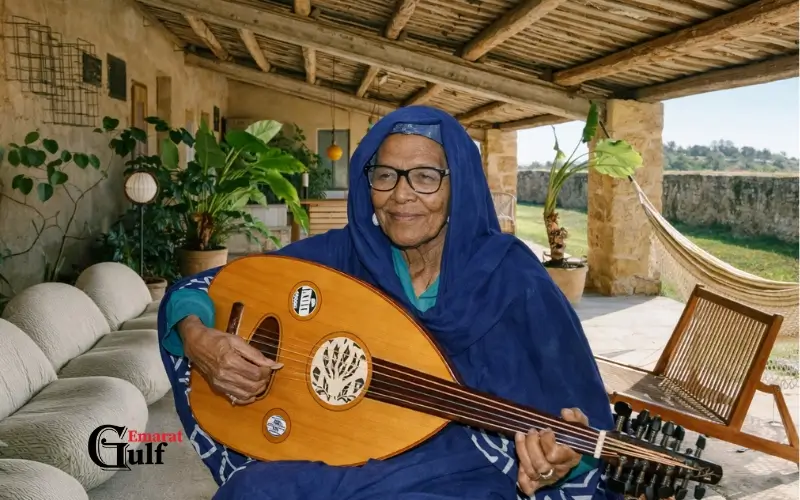
Asma Hamzy is one of the leading personalities in the history of Sudanese music. She was born in 1932. She was the first woman composer in Sudan and the Arab world. The majority of music at the time was dominated by men. Women were not given a lot of chances in the arts. She was able to change these traditions through her talent by following her passion.
There is power and imagination in her life. Her family was a music-loving family. This served to bring out her skills at an early stage. Her songs are representative of Sudanese culture. They incorporate the African rhythms with Arabic forms of music. She produced numerous timeless musical compositions that people still enjoy even after many years.
Personal and Career Overview
| Category | Information |
| Year of Birth | 1932 |
| Nationality | Sudanese |
| Primary Instrument | Oud (Traditional lute) |
| Career Began | Around the 1940s |
| Years Active | Over 60 years |
| Pioneer Status | First female composer in Sudan and the Arab world |
| Number of Compositions | More than 80 |
| Artists Collaborated With | Over 15 singers |
| Years of Cultural Salon | More than 30 years |
| Regional Recognition | Featured on major Arab TV channels |
A Childhood Surrounded by Art and Sound
She was brought up in a family where singing and poetry were held in high esteem, and thus had an emotional attachment to music. The celebrity singers and musicians of the time were constantly invited to her home, and her life was transformed into daytime music. Such meetings enabled her to internalize the music without even considering composing.
This is because, as a young girl,she had aspired to be a singer just like many other girls. But soon she did understand that her voice was not strong enough to perform professionally. She did not give up the passion but instead channeled it into a different outlet.
Her innate musical sense was marvelous. She was able to recall complete songs after listening to them once and whistle melodies. This magic talent could not fail to attract the attention of her father.
Finding the Oud and a Life Long Bond
A Gift That Changed Everything
Her father saw her peculiar talent of replicating melodies while whistling. He is aware of her inherent gift, and so he borrowed an oud (lute) belonging to one of his fellow army members
and took it home to her. This turned out to be the start of a lifetime affair between instrument and artist.
She had no formal training and had to learn how to play by matching strings to her audible melodies. After several days, she would recreate complete songs with great precision. The musician so impressed the first buyer of the oud that he gave it to her as a gift forever, an instrument that she had kept in her life as one of the most valuable items.
Self-Taught Mastery
Asma Hamza Music in Sudan had no teachers in the times when there were no music schools. She perfected her playing by rehearsing, observing, and listening intensively. Every piece of music she listened to was a lesson, and every time she tried to perform a piece of music, her musical intuition grew stronger.
This is the process of natural learning that formed her very distinct style, which was emotional, flowing, and close to Sudanese culture.
The First Steps Into Composition
Creating in Silence
Her composition was a quiet one at first. One of her neighbors requested her to make an accompaniment to a song that was celebrating an occasion in her family. She assented but asked that her name should not be mentioned. The society was undermining young women who were involved in the creation of music at the time.
The song was a hit, and gradually her fame began to rise; however, not many of them knew who was behind the music.
Overcoming Social Barriers
It took courage to be a female composer in mid-20th-century Sudan. Whereas the men were at liberty to perform and compose, the women were criticized and socially pressured. However, she had not stopped, and she was making art due to passion, but not fame.
Her perseverance gradually influenced an attitude and opened doors for other women to join the artistic world.

A Musical Style Shaped by Culture
Blending African and Arabic Traditions
The fact that Sudan is the only country in Africa and among the Arabs made her music identify with them. She frequently employed the pentatonic scale, which is popular in African music, but she combined it with the Arabic melodic formation, which is based on seven-note scales.
This combination generated songs that were conservative and new at the same time- known and emotionally novel.
Inspired by Environment and Community
She was of the view that artists were a creation of the environment. Her compositions were all affected by the rhythms of everyday life, parties and celebrations, poetry, and social events. She did not imitate foreign styles; instead, she concentrated on conveying Sudanese identity by means of music.
Her work turned out to be the linking point between generations and cultures.
Working With Sudan’s Greatest Artists
Voices That Brought Her Music to Life
The majority of her melodies were performed by some of the most well-known singers in Sudan, which helped to spread her songs throughout the country as well as the rest of the country. They included legendary performers who later became the icons of Sudanese music.
Her works were characterized by emotional richness, lyrical harmony, and high cultural coloring.
Collaborations With Renowned Poets
She did not feel that music was independent of poetry. She collaborated very well with the most prominent Sudanese poets, who gave her very strong lyrics that supported her musical vision. Their partnerships saw them produce songs that were ingrained in the national memory.
It is also one of the most well-known poetic alliances whose songs are still sung today in the whole of Sudan.
A Cultural Salon That Shaped Artistic History
A Gathering Place for Creativity
In Khartoum, her own house was a cultural salon where musicians, poets, and singers, even political leaders, used to meet. These were unplanned but very powerful meetings.
New music was tested, artists shared ideas, and fostered the talent of the new artists. Numerous thriving careers were inculcated under this atmosphere of cooperation.
Preserving Sudanese Artistic Heritage
These meetings helped to retain old sounds and forms of poetry and introduced the new musical trends. The salon was crucial in developing contemporary Sudanese music.
A Productive Period With National Cultural Programs
She dealt with cultural projects for a long time in relation to national institutions. This turned out to be one of the most fruitful stages in her career.
She created extensive works of music, including opera in which she blended narratives, jingoism, and classical tunes. A turning point in her artistic life, and one that increased her influence, was a great operetta.
It is also at this time that she discovered and promoted young talents who were to become known performers later.
Mentoring the Next Generation.
Teaching Without Boundaries
Even though she has never studied in a formal music academy, she has taught several young musicians. One of her pupils was later to be one of the most valued composers in Sudan.
She was not secretive about anything she knew because she thought that talent is multiplied when transferred.
A Living Legacy
Her mentorship made sure that the traditions of Sudanese music kept on changing and they were tied back to their origin.
A Vast Collection of Compositions
In her lifetime, she wrote over eighty melodies, most of which have become known songs, and the rest have not been released.
Some of her works were recognized nationally, and some others are held in private by artists who wish to perform them in the future.
In spite of such massive production, she was modest and more concentrated on artistic satisfaction rather than popularity.
Recognition Across the Arab World
Her pioneering contribution later got recognition in the region. She featured on the big Arab TV stations and was awarded the first woman composer in the Arab world.
It was not merely an individual accomplishment, but a kind of milestone for Sudanese women and artists in the region.
Her Philosophy of Creativity
She held that the music comes as poetry, without effort, without coercion. She did not adhere to routines, but she just got inspired. There was a time when I would hear a song in the middle of reading a poem; there was also the time when I was in silent contemplation. She considered composition to be more of an emotional experience as opposed to an art.
Challenges of Modern Music Culture
She later in her life lamented the sudden rise of fast fame and dumbed-down music. Although she was happy to see new talent, she feared that artistic artistry was being lost in expediency and marketability. But she was not defeated, and she was always optimistic that real music would never be deprived of a home.
Influence on Women in the Arts The history of women in art is an extensive field of research.<|human|>Influence on Women in the Arts
Influence on Women in the Arts
Her success was a challenge to society and an indication that women had the power to succeed in composition, leadership, and culture. Her example is quoted by many young Sudanese women not only in reference to music but as a model of boldness in following a creative ambition. She made what was initially impossible a possibility.
Lasting Cultural Impact
Her songs have been a part of Sudanese music. They are learned, practised, and treasured down the generations.
In addition to the songs per se, her narrative embodies:
- Artistic resilience
- Cultural pride
- Female empowerment
- Preservation of tradition
- Innovation within heritage
She did not create music per se, but she transformed Sudanese art history.
Conclusion: A Timeless Musical Icon
The life of Asma Hamzy is an example of the power of passion directed by perseverance. Her path is a historic and an inspiring one, beginning as a young girl whistling tunes, going all the way to a pioneer to break the centuries-long barriers.
Her work is still reverberating in the streets, celebrations,s and cultural memory of Sudan. She is not just a composer, but a representative of artistic freedom and national pride.
Read Also: RTA Eye Test Dubai
FAQ’s
Who was Asma Hamza?
Asma Hamzy was a Sudanese composer and musician who was a pioneer female composer in Sudan and the Arab world.
When was Asma Hamza born?
She was born in 1932 in Sudan.
Why is Asma Hamza famous?
She is known to tear down social boundaries and influence Sudanese music with her own compositions.
What was the instrument that Asma Hamza played?
Her primary instrument was the oud, which is a Middle Eastern stringed instrument.
What is the manner in which Asma Hamza was taught music?
She was self-educated and gained experience listening to singers and singing at home.
What was the type of music Asma Hamza composed?
Her music incorporated African beats with the Arabic musical cultures.
Does Asma Hamza collaborate with popular singers?
Surely, most popular Sudanese singers sang her works.
What was the number of songs that Asma Hamza composed?
In the course of her career, she created over eighty musical works.
So what were the challenges that Asma Hamza encountered?
She had social limitations and constraints against women in music, and she persevered with determination and talent.
How has Asma Hamzy left a legacy?
She is remembered as a woman who paved the way for women in Sudanese music.